
The ancient quarry at Demre: the story of the stone, from Lycia to today
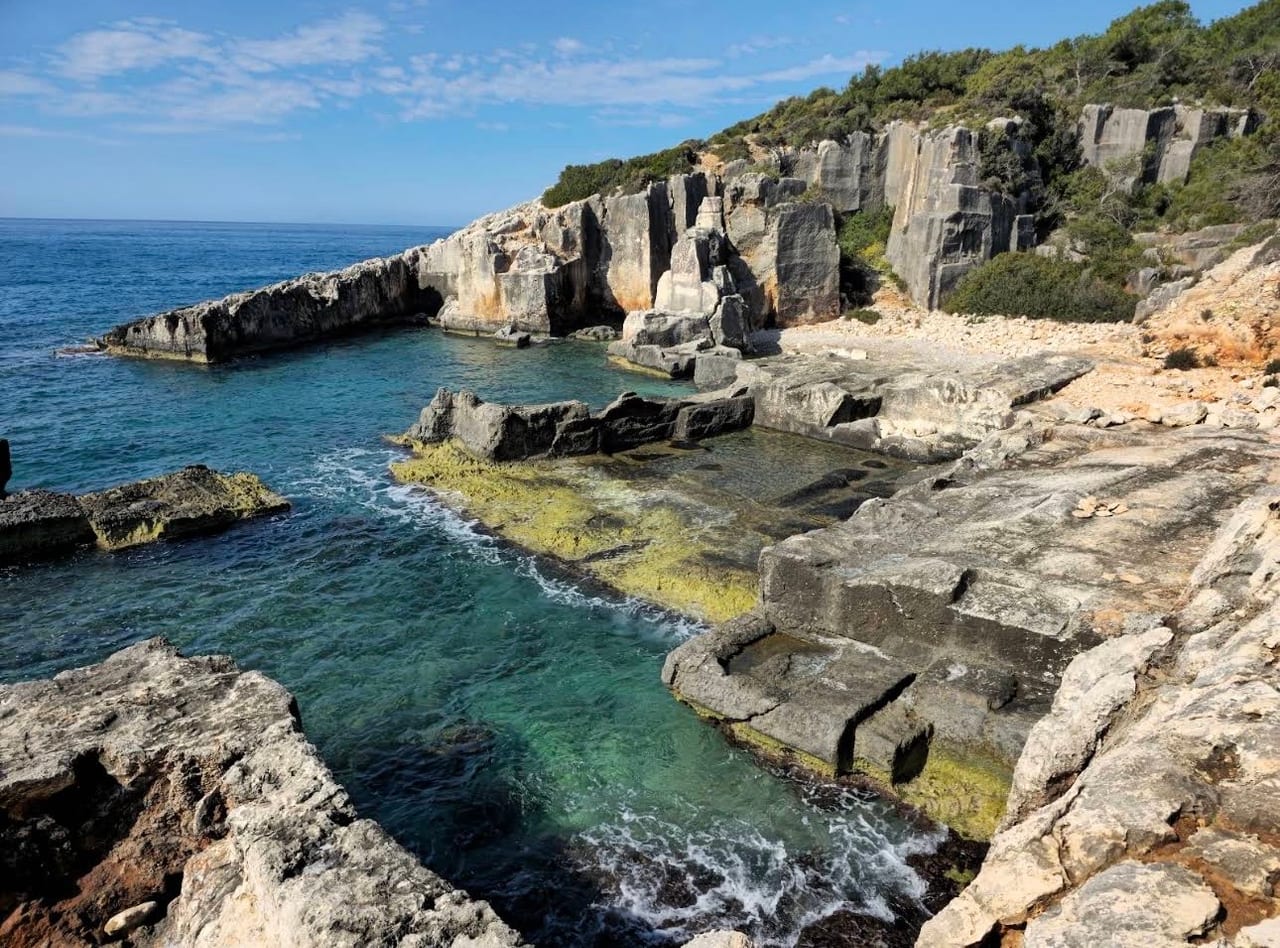
There is a question anyone looking at the theatre of Myra, at the harbour buildings of Andriake, at the walls and the castles ought to ask, and hardly anybody does: where did this stone come from?
The answer is just west of Demre, at the edge of the sea.
It also has a name, which we did not know when this piece was first written: Zümrütkaya Ancient Quarry. Locally it is called “Taşkesiği” — the stone cut. Zümrütkaya is the old name of Büyükkum, the neighbourhood it sits in.
Where it is
The ancient quarry is on the headland immediately west of Sülüklü beach. It is about two kilometres from our harbour at Çayağzı as the crow flies — but those two kilometres are over water, and that is exactly the point.
What the official record says
The quarry is registered in the Antalya Cultural Heritage Inventory under number 842:
| Name | Zümrütkaya Ancient Quarry |
| Local name | Taşkesiği |
| Location | Demre, Büyükkum district, Sülüklü |
| Period | 2nd century AD — Roman Imperial |
| Size | About 50 × 50 metres |
| Position | 1.33 km south-east of Andriake |
| 300–350 m west of Güvercin Adası | |
| Status | First-degree archaeological site (since 2000) |
Its busiest stretch was the first half of the 2nd century AD, when the city’s building work was at its peak — the quarry was running while Myra and Andriake were growing.
⚠️ Go knowing it is a first-degree archaeological site. That people swim there does not make it unprotected: nothing is taken, nothing is written on anything.
How to get there
The place you can drive to is Sülüklü beach. The quarry is beyond it, and driving up to the face of it is not possible. Past the beach, people cover the rest like this:
- Swimming — the most common way.
- By kayak or paddleboard — the easiest if you want your things to stay dry.
- Walking along the shore — possible, but not easy. It is rocky and asks for a steady footing.
- In a small boat or dinghy — coming alongside from the sea.
Take closed or water shoes, water and a hat. There is no shade, and the rocks are slippery when wet.
What you see there
An ancient quarry does not look like a ruin; on the contrary it looks excessively regular — and that is what makes it recognisable. What is here:
- Cut faces descending in steps. Because the stone was taken layer by layer, the rock face comes down like a staircase. Nature does not make that shape.
- Sheer, flat walls. The seaward face of the rock is cut with sharp corners.
- Blocks never lifted from their beds. Stones separated on all four sides but never prised out. These are the most legible part of the quarry: a moment that stopped in the middle of the work.
- Channel marks. The narrow grooves cut to free a block from the bedrock.
- Cuts that run into the water. The worked faces continue below sea level.
That last item is worth attention on its own. If a surface cut in antiquity now lies underwater, the sea has risen since — another piece of evidence, a few kilometres away, of the same movement that made the Sunken City at Kekova.
Where the stone went — no longer a guess
When this piece was first written we said the stone here went to Myra and Andriake, but that was a conclusion drawn from what is visible on the rock. Now it is measured.
Archaeometric analyses have shown that blocks from this quarry were used in the buildings of Myra and Andriake. Where the stone went is no longer reasoning; it is a laboratory result.
How much came out is known too. The figures are from Prof. Dr. Nevzat Çevik, director of the Myra–Andriake excavations:
| Quarry | Block stone extracted |
|---|---|
| East quarry | 13,500 m³ |
| West quarry | 2,500 m³ |
Sixteen thousand cubic metres — all of it out of this fifty-metre rock, by hand and by sea.
One more thing: it was not only building stone. Sarcophagus troughs and their lids were cut here as well, and the traces are still visible. Some of the sarcophagi in Myra’s rock tombs came from this shore.
Why the quarry is here needs no explaining once you have seen it: the stone is at the sea’s edge. A block that has been cut is not carried for kilometres over land — it goes straight onto a boat and is taken to the harbour. Given that in antiquity heavy loads travelled by water rather than by road, the site of the quarry was not a preference but a necessity.
On this coast stone was not simply building material: where you could quarry it decided where you could put a city. Quarry, harbour and city had to be close to one another — and here all three are within a few kilometres.
It does not combine with the boat tour
Let me say this plainly, because it will be asked: the quarry is not on the route of our boat tour. The Kekova tour goes east from Çayağzı, towards the Kekova islands; the quarry is in the opposite direction and is not a stop on the trip.
It is a place for people interested in history, to go to on their own. Set aside half a day at Sülüklü beach, swim or paddle across, and look at what you find knowing that it is the same stone as the theatre of Myra.
Sources
The things visible to the eye in this piece — the cutting faces, the blocks still attached, the cuts running below the water — were written by someone who lives in Demre and works this coast every day.
The measured and dated parts come from:
- Antalya Cultural Heritage Inventory, record no. 842 — Zümrütkaya Ancient Quarry. The research in that record is by Fatih Özdel and Akın Gültekin, from T.C. Antalya Valiliği – Antalya Kültür Envanteri.
- Prof. Dr. Nevzat Çevik, director of the Myra–Andriake excavations — the stone volumes, the archaeometric result and the sarcophagus workshop are from his own post. The quarry was also covered by TRT Haber.
We will update this page as new findings come in.